Indian Startup Map Research · India report
India Startup Register 2026
4,53,192 companies on the Startup India register, snapshot August 2026, across 36 states and 712 districts with a page. 2,31,835 are DPIIT recognised.
₹249, GST included, one-time, with every refreshed edition for 12 months. Or Library, ₹749 a year, for all 138 reports.
Judge the free Lucknow report first: the whole thing is open. If your access isn't active within 1 working day of payment, we refund in full: trust@indianstartupmap.com.
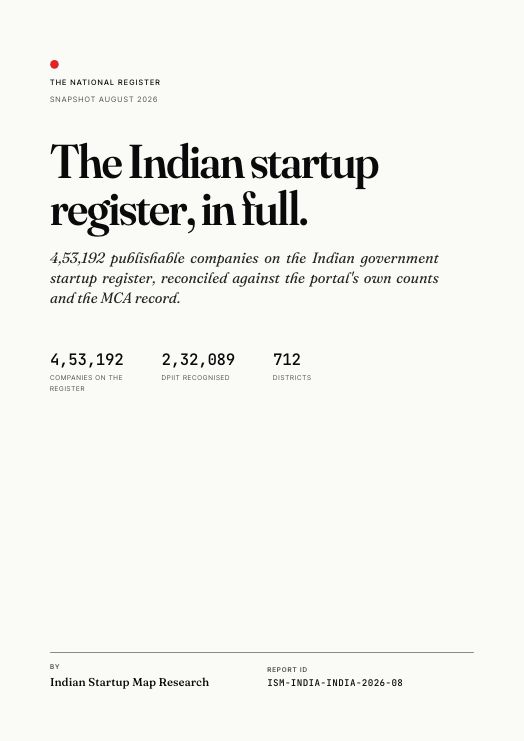 71 pages
 Chapter 1 · free
The register at a glance
The numbers the report opens with, counted from the August 2026 snapshot. The same figures are on The numbers, and how they check out, and they will not differ.
| Startups on the register | 4,53,192 |
|---|---|
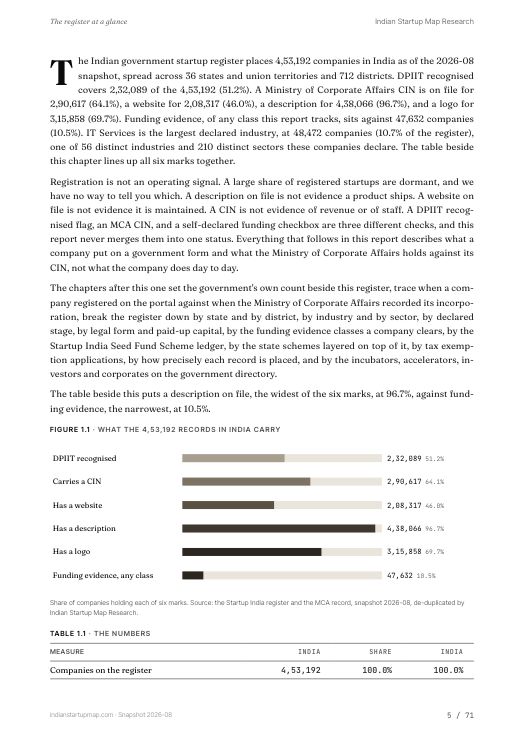
| DPIIT recognised | 2,31,835 (51.2%) |
| With a description plus a CIN or a website | 2,28,415 (50.4%) |
| With a funding signal of any class | 47,696 (10.5%) |
| Placed to a street | 1,64,879 (36.4%) |
| The government's own census | 4,67,663 |
| States and union territories | 36 |
| Districts with a page (25+ startups) | 712 |
| Industry categories | 56 |
| Seed Fund approved | Rs 755.3 crore across 175 incubators in 26 states |
The government's count beside ours
| Our count | 4,53,192 |
|---|---|
| India, the government's whole register | 4,67,663 |
| Difference | -14,471 (-3.1%) |
A gap is expected and is not an error in either number: ours counts resolved companies after merging duplicate profiles, the government's counts profiles.
What stands out
The register holds 4,53,192 companies against the government's own census of 4,67,663; the difference is duplicate profiles merged and records we may not republish, and the report reconciles the two state by state. Maharashtra is the largest state with 74,540, Delhi the largest district with 42,792, and IT Services the largest category with 48,097.
47,696 companies carry a funding signal of some class, most of them the self-declared checkbox on the government form, and the report keeps the four evidence classes apart. The one hard money on the register is the Seed Fund: Rs 755.3 crore approved across 175 incubators, Rs 526.4 crore disbursed. 1,64,879 companies can be placed to a street; 2,75,359 are known only to their district.
Registration is not an operating signal. A large share of registered startups are dormant, and we have no way to tell you which. How we counted.
Composed from the August 2026 counts. Edition 1 replaces this with the report's own written summary.
Inside the report
16 chapters across 71 A4 pages. Each names its fields, its chart or table, and the caveat it carries. Chapter 1 is on this page; the rest open with a purchase, or in the free Lucknow report.
- 01 The register at a glance pp. 4-6 Free, above
- 02 The government's count beside ours pp. 7-9
- 03 How the register grew pp. 10-14
- 04 The states pp. 15-18
- 05 The districts pp. 19-23
- 06 What India's startups do pp. 24-27
- 07 Stage pp. 28-29
- 08 Legal form and capital pp. 30-32
- 09 Funding evidence pp. 33-36
- 10 The Seed Fund ledger pp. 37-46
- 11 The state schemes pp. 47-48
- 12 Tax exemption applications pp. 49-51
- 13 Where the register is placed pp. 52-56
- 14 Organisations pp. 57-62
- 15 Methodology and limitations pp. 63-65
- 16 Appendix pp. 66-70
What the pages look like
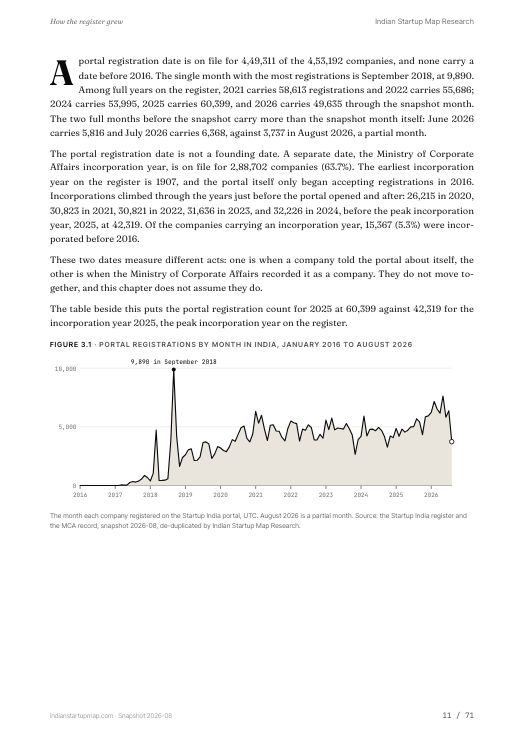
Pages from the 71-page India PDF: the cover, the first data table and the first chart. Every chapter is set the same way, A4, with the caveat it needs at the foot of the page.
Who it is for
- Sales and lead-gen teams
- A filterable list with website and CIN. Registration is not activity and we say so; every row carries what the register holds, you can filter to companies with all six evidence marks, and the first 25 rows of any filter are free.
- Ecosystem professionals
- A citable, designed report for a deck or a tender: eight things the site does not have, from the monthly curve since 2016 to the tax-exemption applications, with Lucknow open in full so you can judge the series before buying into it.
- Investors and researchers
- Companies by industry, district, stage and evidence, in four honest classes and never one "funded" boolean, plus the exemption applications nobody else publishes. We hold no amounts and we never fake them.
Pricing
| Plan | Price | What it opens | Action |
|---|---|---|---|
| Report | ₹249 one-time | One report as a PDF and as chapters in the portal, and every refreshed edition of it for 12 months. Explore stays at the free-account level. | Get the India report |
| Library | ₹749 per year | All 138 reports and their monthly editions, the feed with rows, Explore at 200 rows per search, backer portfolios in full, 10 saved searches. No export. | Get Library |
| Pro | ₹2,249 per year | Everything in Library, plus every row in Explore, CSV and XLSX export (5,000 rows a file, 50,000 rows and 20 distinct scopes per rolling 30 days), saved searches with monthly alerts, backer portfolio export. One seat. | Get Pro |
| Data licence | By conversation | The full set, older snapshots, and a feed or an API for your own systems. One email with what you are building; no price is printed because the answer depends on it. | trust@indianstartupmap.com |
One report ₹249. Three reports' worth, ₹749, is all 138.
Each term is a separate one-time payment; nothing auto-charges, and we remind you 7 days and 1 day before a term ends. Prices include GST; a GST invoice goes to your email, with your GSTIN on it if you give one. The full set, older snapshots or a feed: by conversation, trust@indianstartupmap.com.
Judge the free Lucknow report first: the whole thing is open. If your access isn't active within 1 working day of payment, we refund in full: trust@indianstartupmap.com.
Five questions
- What is in the India report?
- 16 chapters over 71 pages: The register at a glance, The government's count beside ours, How the register grew, The states, and 12 more, ending in the methodology and an appendix. It comes as a PDF and as chapters inside the research portal, and one purchase covers every refreshed edition of this report for 12 months.
- Is it just the Indian Startup Map website printed to PDF?
- No. Eight things the site does not have: the monthly registration curve since 2016, capital bands, every pincode ranked, the peer table, the government's count beside ours, the 60 best-evidenced in one table, the Seed Fund ledger, and the tax-exemption applications. The free chapter on this page is the one part that overlaps with The numbers, and how they check out, and the whole Lucknow report is open so you can see the other 15 chapters before paying for any.
- How fresh is the India report?
- It is built from the August 2026 snapshot of the register, edition 1. The register is swept monthly and each sweep produces a new edition; a Report buyer receives every edition of this report for 12 months. Nothing in it claims growth across snapshots until two exist to compare.
- Can I get the list of India startups instead?
- The report is chapters, not rows. The rows are in Explore on the research portal: the count for any filter is free, the first 25 rows with website and CIN on a free account, 200 per search on Library, and every row with a CSV or XLSX export on Pro, 5,000 rows a file and never the address line.
- What does "registered" mean here?
- Registration is not an operating signal. A large share of registered startups are dormant, and we have no way to tell you which. A startup on this register filled in a Startup India profile. 2,31,835 of India's 4,53,192 carry DPIIT recognition, which is a status the portal shows and not a check we ran. Registration is not incorporation, and it is not activity.
India Startup Register 2026: 16 chapters, 71 pages, the PDF within seconds of payment.
Judge the free Lucknow report first: the whole thing is open. If your access isn't active within 1 working day of payment, we refund in full: trust@indianstartupmap.com.